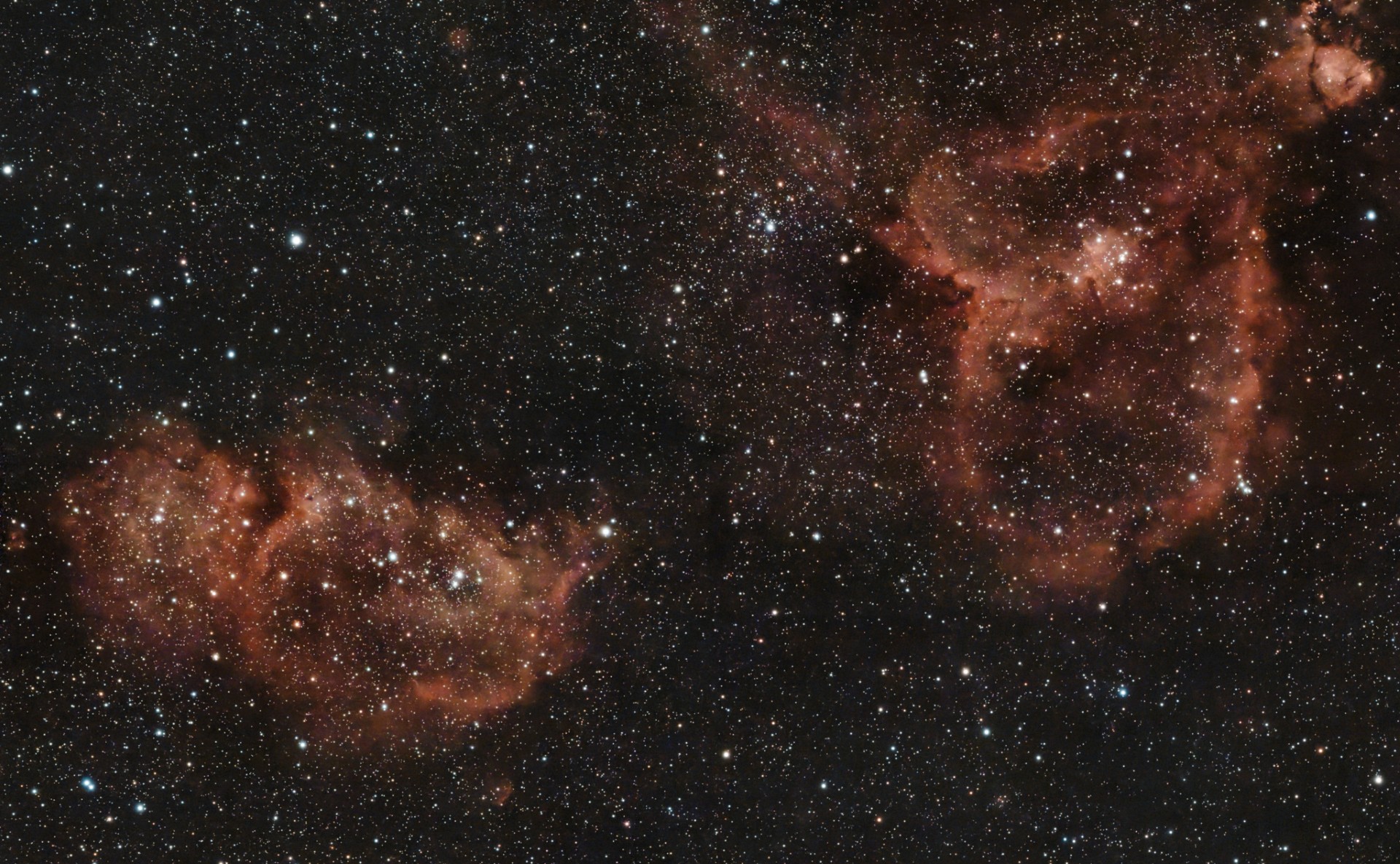
The Heart and Soul Nebulae are two of the most spectacular emission nebulae in the winter sky — a vast complex of glowing hydrogen gas stretching across roughly five degrees of Cassiopeia. Together they're sometimes called the Embryo Cluster region, and capturing both in a single image from a garden telescope requires one thing above all: the DWARF 3's mosaic mode.
Each nebula alone fills the DWARF 3's field of view. Getting both meant stitching two separate sessions into a two-panel mosaic — a first for me, and a genuine test of what the smart telescope's built-in mosaic planning is capable of.
About the Heart & Soul Nebulae (IC 1805 & IC 1848)
The Heart Nebula (IC 1805) sits roughly 7,500 light-years away in Cassiopeia and gets its distinctive shape from the powerful stellar winds and radiation pouring from the open cluster Melotte 15 at its centre. The cavity carved by those young, hot stars creates the recognisable cardiac silhouette when imaged in hydrogen-alpha.
Just east of it, the Soul Nebula (IC 1848) — also called the Embryo Nebula — is a physically connected region of star formation, lying at a similar distance. Together the pair spans roughly 300 light-years of actual space, one of the largest star-forming complexes within reach of amateur equipment.
Both respond beautifully to duo-band narrowband imaging, with the hydrogen-alpha emission dominating the image in vivid reds and pinks.
Capturing the Mosaic with the DWARF 3
Session Details
| Parameter | Value |
|---|---|
| Telescope | DWARF 3 Smart Telescope |
| Filter | Duo-band (Hα / OIII) |
| Mode | Two-panel mosaic |
| Location | New Forest, Hampshire · Bortle 4 |
| Date | November 2025 |
| Integration time | ~75 min per panel · ~2.5 hrs total |
| Sub-exposure | 15 seconds |
| Stacking | DWARFLAB Stellar Studio |
| Post-processing | DWARFLAB Stellar Studio · Apple Photos |
| Conditions | Seeing: good · Transparency: very good |
The DWARF 3's mosaic mode handled the panel planning automatically — I centred on a midpoint between the two nebulae and let the app calculate the required pointings, with enough overlap for a clean stitch. The Heart panel came first as it transited higher, then the DWARF slewed east to the Soul once the first integration was complete.
The trickiest part of this session wasn't the imaging — it was the mosaic assembly in post. Matching the hydrogen-alpha gradients across the two panels took careful attention to the overlap region, with Stellar Studio handling the per-panel stacking and Apple Photos used to blend and balance the final combined image.
Mosaic mode, duo-band filter, automated tracking — the DWARF 3 makes widefield mosaic imaging genuinely accessible from a garden setup.
Affiliate link — I earn a small commission at no extra cost to you.
Processing in Stellar Studio & Apple Photos
Both panels were stacked separately in DWARFLAB Stellar Studio with starless processing enabled. I then brought the two exports into Apple Photos for mosaic assembly, carefully matching brightness and colour across the join. Working starless made the blend significantly cleaner — the stars were added back afterwards to avoid doubling artefacts at the panel boundary.
Final processing in Apple Photos focused on lifting the mid-tones to reveal the fainter outer shells of both nebulae, while keeping the brighter core regions of Melotte 15 and the Soul's central cluster from clipping.
Final Image & Reflections
This is the widest deep-sky image I've produced with the DWARF 3, and seeing both nebulae together in a single frame is genuinely impressive. The scale of the Heart & Soul complex only becomes apparent when you can compare the two side by side — each one alone is vast, but together the sheer extent of this star-forming region is humbling.
The mosaic join is essentially invisible in the final image, which I was pleased with. Next time I'd push each panel to 90 minutes of integration to pull out more of the faint outer emission that surrounds both nebulae.