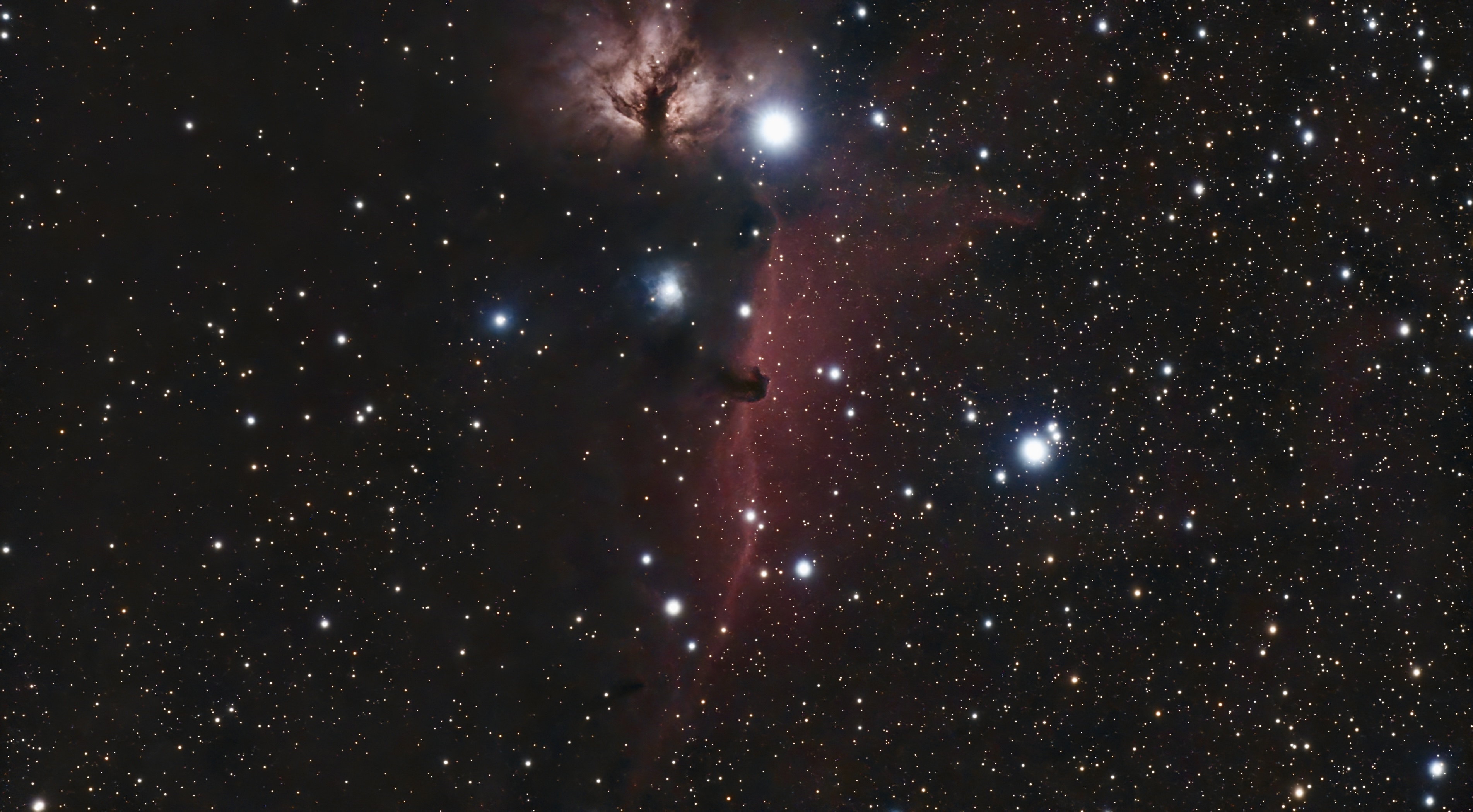
One of the most iconic targets in the winter sky sits just below Orion's Belt — the Horsehead Nebula, a dark cloud of dust silhouetted against a glowing hydrogen backdrop. Beside it, the Flame Nebula blazes with ionised gas lit up by the nearby star Alnitak. From my Bortle 4 site in the New Forest, Hampshire, this pair was high on my list for the DWARF 3's first winter season.
What makes this target special — and tricky — is the contrast. The Horsehead (Barnard 33) is a dark nebula, only visible because of the bright emission nebula IC 434 behind it. You need good sky transparency, the right filter, and enough integration time to bring both objects out without blowing the core of the Flame.
About the Horsehead & Flame Nebulae
The Horsehead and Flame are physically associated — both lie roughly 1,375 light-years away in the Orion Molecular Cloud, one of the most active star-forming regions in the galaxy. The Horsehead itself is a pillar of cold molecular gas being slowly eroded by ultraviolet radiation from Sigma Orionis above it. The Flame is a reflection and emission nebula lit by Alnitak, the easternmost star in Orion's Belt.
For astrophotographers, this pair rewards narrowband imaging: the hydrogen-alpha emission that makes the Horsehead's backdrop glow red is exactly what a duo-band filter captures best.
Capturing the Horsehead with the DWARF 3
Session Details
| Parameter | Value |
|---|---|
| Telescope | DWARF 3 Smart Telescope |
| Filter | Duo-band (Hα / OIII) |
| Location | New Forest, Hampshire · Bortle 4 |
| Date | December 2025 |
| Integration time | ~90 minutes |
| Sub-exposure | 15 seconds |
| Stacking | DWARFLAB Stellar Studio |
| Post-processing | DWARFLAB Stellar Studio · Apple Photos |
| Conditions | Seeing: good · Transparency: excellent |
The session started just after Alnitak cleared the treeline to the south-east. I used the DWARF 3's plate-solving to centre on the Horsehead and let the automated EQ tracking lock on. With the duo-band filter active, the hydrogen-alpha signal built up quickly — within the first 20 minutes the structure of Barnard 33 was already visible in the live stack.
The biggest challenge was balancing the Flame Nebula's bright core against the subtler background of IC 434. Too many subs and the Flame blooms; too few and the Horsehead disappears into noise. I settled on around 90 minutes of total integration, keeping individual exposures at 15 seconds to avoid the core saturating.
Every image on this site was captured with the DWARF 3. Automated goto, EQ tracking, plate solving, and in-app stacking — all from a garden in the New Forest.
Affiliate link — I earn a small commission at no extra cost to you.
Processing in Stellar Studio & Apple Photos
The raw stack came out of DWARFLAB Stellar Studio with solid signal in both the hydrogen-alpha and OIII channels. I used the starless processing mode in Stellar Studio to handle the star reduction — Alnitak is bright enough to bleed across neighbouring pixels if you're not careful — then brought the starless nebula back together with a star layer in Apple Photos.
Final colour grading was done in Apple Photos: a gentle push to the reds and oranges to warm up the Flame, with the blacks pulled down to deepen the void around the Horsehead. The Horsehead itself needed very little work — the contrast between the dark pillar and the glowing IC 434 background was already clean from the stack.
Final Image & Reflections
This is probably my favourite capture from the DWARF 3's first winter season. The Horsehead is instantly recognisable even at this focal length, and the Flame shows real structure — the dark lane running through its centre is clearly visible. Bortle 4 from the New Forest makes a genuine difference here: the sky background is dark enough for the hydrogen-alpha backdrop to glow without needing aggressive noise reduction.
If I were to repeat this session, I'd push integration closer to two hours and experiment with longer sub-exposures — 30 seconds might bring out more of the fainter outer regions of the Flame without saturating the core. The target will be back in the winter sky from October, so there's plenty of time to revisit it.