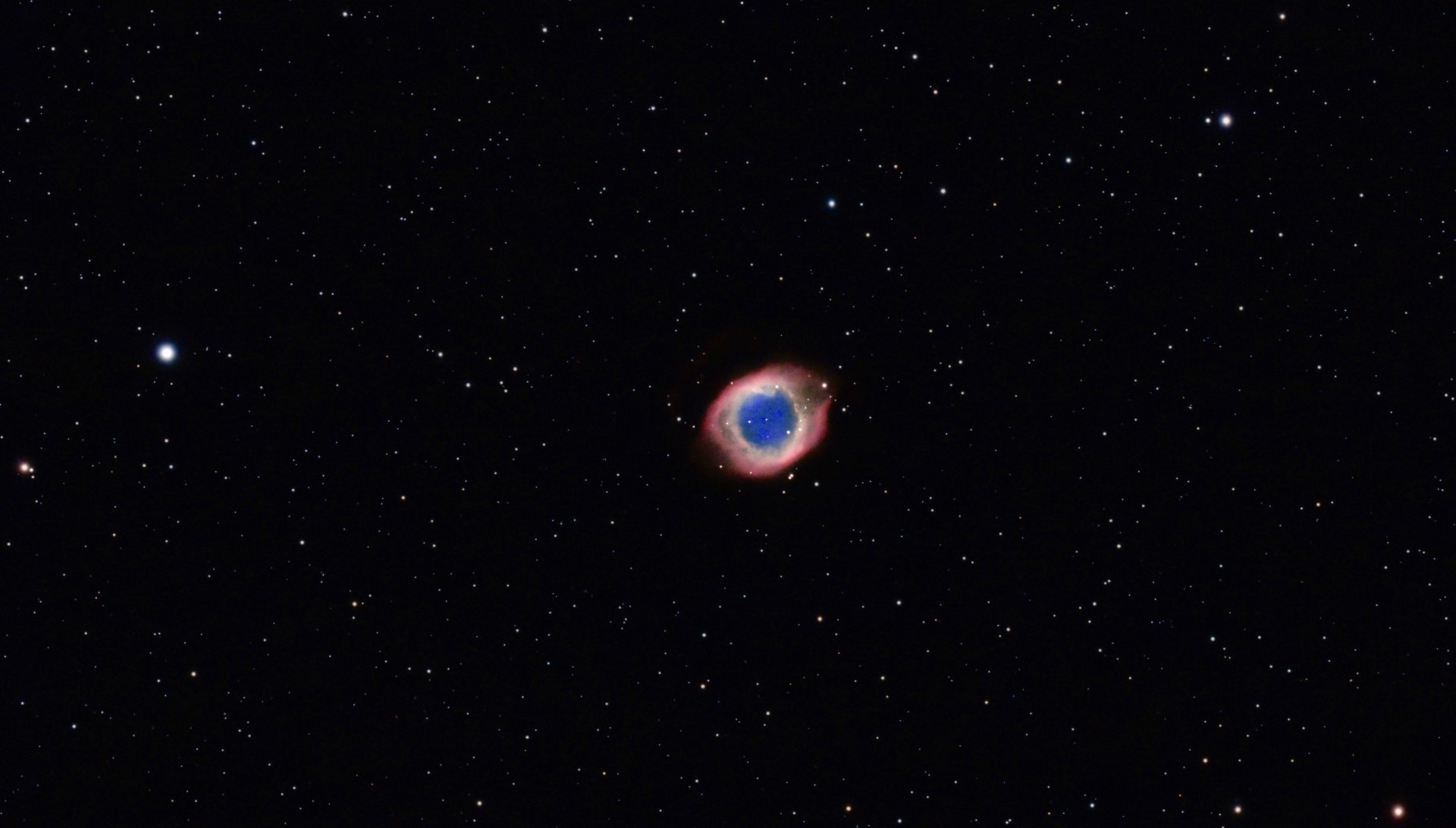
The Helix Nebula is the closest planetary nebula to Earth — a vast shell of glowing gas expelled by a dying star some 655 light-years away in Aquarius. Known colloquially as the Eye of God, it's one of the largest planetary nebulae on the sky, spanning roughly half a degree — almost the apparent width of the full Moon. From Hampshire, it never climbs high, which makes capturing it from the New Forest a genuine challenge.
This was one of my more technically demanding sessions with the DWARF 3. Low altitude means atmospheric dispersion, turbulence, and more sky glow to fight through. But the result — that unmistakeable blue-green iris staring back at you — makes it entirely worth the effort.
About the Helix Nebula (NGC 7293)
The Helix (NGC 7293) is what our own Sun will eventually become — after exhausting its hydrogen fuel and expanding into a red giant, it will shed its outer layers in a series of pulses, creating a glowing shell of ionised gas illuminated by the intensely hot white dwarf at its centre. The OIII emission gives the Helix its characteristic blue-green colour, while the outer shell glows in hydrogen-alpha red.
At 655 light-years, it's close enough that the shell subtends a large apparent area, which is both a gift — plenty of detail to resolve — and a complication, because you need a wide enough field of view to fit the whole structure in without cropping the outer halo.
Capturing the Helix Nebula with the DWARF 3
Session Details
| Parameter | Value |
|---|---|
| Telescope | DWARF 3 Smart Telescope |
| Filter | Duo-band (Hα / OIII) |
| Location | New Forest, Hampshire · Bortle 4 |
| Date | October 2025 |
| Integration time | ~2 hours |
| Sub-exposure | 15 seconds |
| Altitude at transit | ~20° above horizon |
| Stacking | DWARFLAB Stellar Studio |
| Post-processing | DWARFLAB Stellar Studio · Apple Photos |
| Conditions | Seeing: fair · Transparency: good |
The Helix transits at only around 20 degrees above the southern horizon from Hampshire — that's a lot of atmosphere to image through. I waited until it was within an hour of transit before starting the session, and ran the integration for as long as the object remained usable altitude-wise. The DWARF 3's EQ tracking held rock-solid throughout.
The duo-band filter was essential here — Aquarius is a region of relatively blank sky, so light pollution isn't the main enemy, but the sheer faintness of the outer halo is. The OIII channel was where most of the detail lived, with the inner ring structure coming through beautifully in the stacked frame.
The DWARF 3's automated tracking and plate-solving kept the Helix centred and tracked for two hours without any manual adjustment — essential when imaging near the horizon.
Affiliate link — I earn a small commission at no extra cost to you.
Processing in Stellar Studio & Apple Photos
The stack showed strong OIII signal in the inner nebula and reasonable Hα in the outer shell. I processed the result in Stellar Studio, boosting the OIII to bring out the inner ring structure and carefully lifting the Hα to reveal the faint outer halo without pulling up the sky background too aggressively. Final colour and contrast adjustments were made in Apple Photos.
Atmospheric dispersion at this altitude creates a subtle colour fringing in raw subs — keeping the starless processing in Stellar Studio aggressive enough to remove the worst-affected stars near the horizon helped keep the background clean.
Final Image & Reflections
Despite the challenging altitude, the Helix's structure came through clearly — the inner ring, the central cavity, and the beginnings of the outer halo are all visible. It's not the sharpest image in the gallery for obvious reasons, but there's something deeply satisfying about capturing a planetary nebula this large and detailed from a garden in Hampshire.
I'll return to this target next autumn, ideally on a night of exceptional seeing. Two hours of integration from 20° altitude is a genuine limitation — three hours on a steadier night would make a meaningful difference to the outer halo detail.