Most of what I chase with the DWARF 3 is invisible to the naked eye — faint wisps of nebulae millions of light-years away, requiring hours of integration to tease out. The Moon is the opposite problem entirely. It's so bright it saturates most exposures within milliseconds, and on nights when it's up, it floods the sky with enough light to wash out any nearby deep-sky targets.
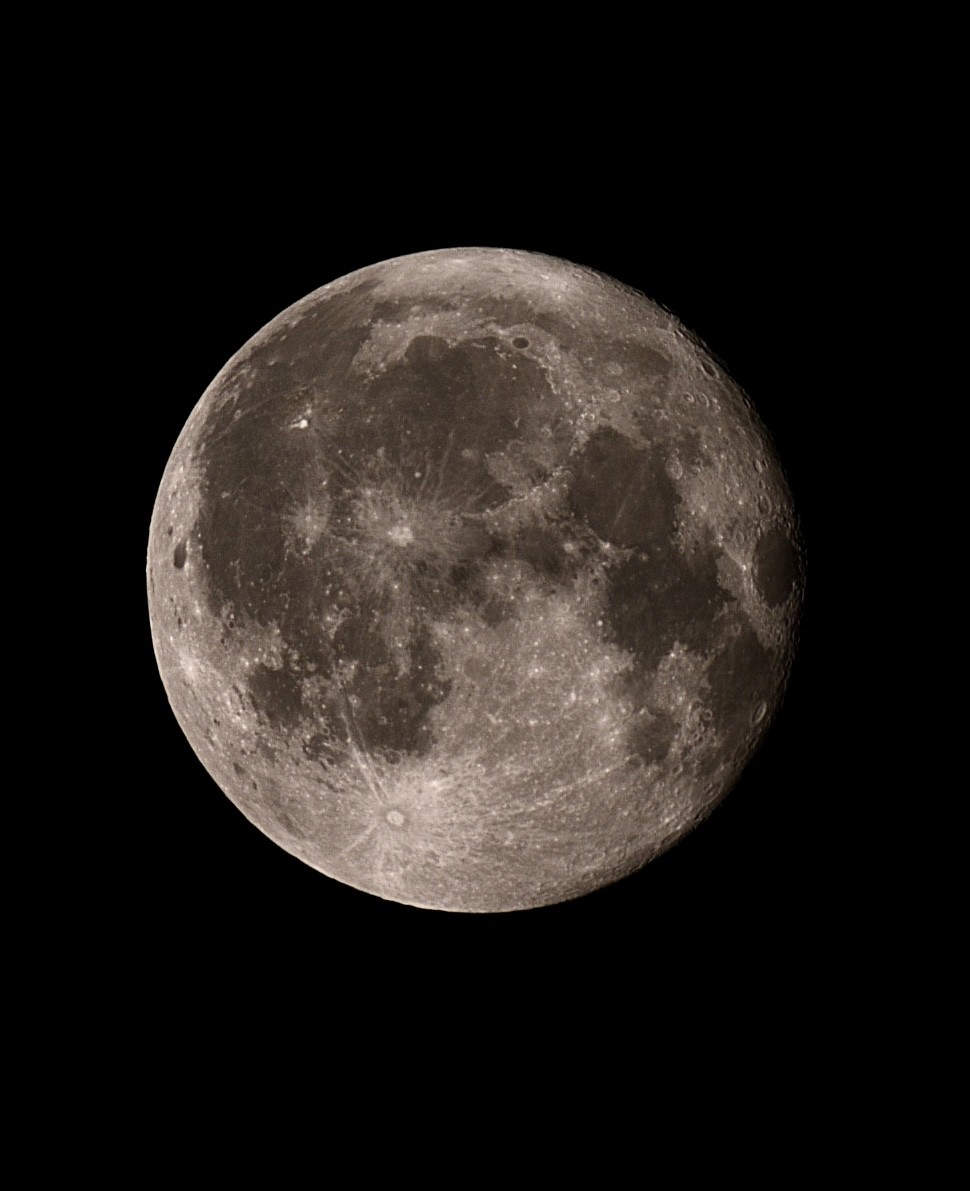
So on the evening of 12 July 2025, with the Moon at 78% illumination and sitting in Sagittarius, I turned the DWARF 3 on it deliberately — a chance to explore a completely different style of imaging and see what the telescope could resolve across the lunar surface.
About the Waxing Gibbous Moon
The Moon at waxing gibbous phase is one of the most photogenic phases for detail — not full Moon, which is often surprisingly flat and crater-less due to the lack of shadow, but just past the terminator line where the grazing sunlight throws craters, mountain ranges, and rilles into dramatic relief. At 78% illumination, the terminator cuts through the eastern maria, placing some of the most rugged highland terrain in sharp shadow.
The average distance to the Moon at time of capture was approximately 384,400 km — a little over a light-second away. Photons from the Sun reflecting off the lunar surface take just over a second to reach us.
Capturing the Moon with the DWARF 3
Session Details
| Parameter | Value |
|---|---|
| Telescope | DWARF 3 Smart Telescope |
| Filter | None (broadband / no filter) |
| Phase | Waxing Gibbous · 78% illumination |
| Position | Visible in Sagittarius |
| Date & Time | 12 July 2025 |
| Location | New Forest, Hampshire |
| Exposure | Short exposures to avoid overexposure |
| Stacking | DWARFLAB Stellar Studio (lunar mode) |
| Post-processing | Apple Photos |
Lunar imaging is a complete departure from deep-sky work. Instead of maximising exposure time to gather faint signal, the goal is to use the shortest exposures possible — long enough to freeze atmospheric turbulence (seeing), short enough to avoid blowing out the bright highlands. The DWARF 3's lunar mode handles the exposure automatically, which takes a lot of the guesswork out of it.
The seeing on this particular evening was good — the limb of the Moon was steady and well-defined, and the detail across the terminator region resolved clearly in the live stack within minutes.
Whether you're imaging faint deep-sky objects or the Moon, the DWARF 3 handles both beautifully — switching between modes with minimal setup from a New Forest garden.
Affiliate link — I earn a small commission at no extra cost to you.
Processing in Stellar Studio & Apple Photos
Lunar stacks require very different treatment from nebula images. The goal is sharpness and contrast, not noise reduction. DWARFLAB Stellar Studio's stacking handled the frame-by-frame alignment well, rejecting frames affected by atmospheric blur. The resulting stack was already impressively sharp, needing only light sharpening and a modest contrast boost in Apple Photos to bring out the crater walls along the terminator.
No colour processing was needed — the Moon in broadband light has only very subtle colour variations (mostly related to mineral content of the maria), and I kept the image in natural greyscale-leaning tones rather than pushing artificial colour.
Final Image & Reflections
The detail across the terminator region is the highlight of this image. The crater Tycho — visible in the southern highlands — shows its characteristic bright ray system even at this phase, while the flat floors of the Mare Imbrium and Mare Serenitatis contrast sharply with the rugged southern highlands. The Apennine mountain range, running along the edge of Imbrium, casts long shadows that are clearly resolved.
Lunar imaging is a good reminder that the closest object in the night sky is also one of the most rewarding — and that the DWARF 3 isn't just a deep-sky machine. On nights when the Moon is too bright for nebulae, it's a perfectly good reason to point at the Moon itself instead.