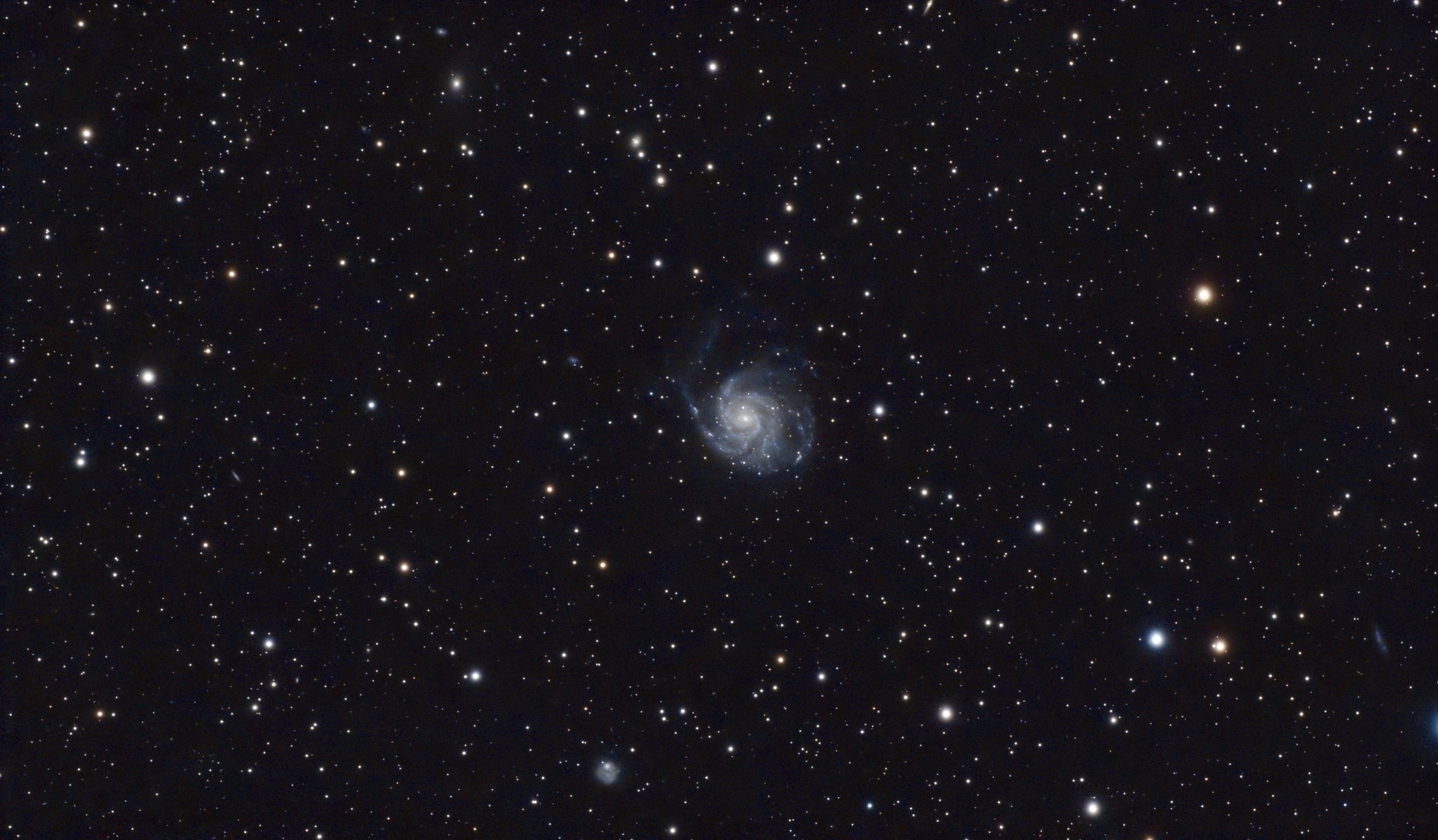
Galaxy season is here. As Ursa Major climbs high in the spring sky, M101 — the Pinwheel Galaxy — becomes one of the most rewarding targets available from the New Forest. It's a face-on grand design spiral, huge in apparent size at just over 28 arcminutes across, and at 21 million light-years it sits in the relatively nearby cosmic neighbourhood. From a Bortle 4 site with a night of steady transparency, the arm structure is within reach even with a smart telescope.
This was a session I'd been waiting on for a few weeks — M101 needs decent altitude to show its best, and I wanted a night with low humidity and no Moon interference. March 15th delivered both, and the DWARF 3 ran unattended for the full integration while I went inside.
About M101 the Pinwheel Galaxy (NGC 5457)
M101 (NGC 5457) was discovered by Pierre Méchain in 1781 and catalogued by Messier the same year. It's a type SAB(rs)cd spiral — meaning it has a weak bar structure and loosely wound arms — and it's one of the largest galaxies in the Messier catalogue in terms of apparent angular diameter. That large apparent size is both an asset and a complication: there's lots of detail to resolve, but the surface brightness per square arcsecond is relatively low, which means you need clean skies and decent integration time to lift the outer arms out of the noise.
M101 is also famous as a supernova host. SN 2023ixf — detected in May 2023 — was one of the closest supernovae observed in decades and briefly made M101 one of the most-photographed galaxies in the amateur community. No such fireworks on this session, but the galaxy's asymmetric structure is striking even without them: the spiral arms are noticeably lopsided, pulled and distorted by gravitational interactions with its smaller companion galaxies.
Capturing M101 with the DWARF 3
Session Details
| Parameter | Value |
|---|---|
| Telescope | DWARF 3 Smart Telescope |
| Filter | Astro (430–690nm) |
| Gain | 80 |
| Sub-exposure | 45 seconds |
| Frames stacked | 250 |
| Total integration | ~3 hours 7 minutes |
| Location | New Forest, Hampshire · Bortle 4 |
| Date | 15 March 2026 |
| Altitude at transit | ~68° above horizon |
| Stacking | DWARFLAB Stellar Studio |
| Post-processing | DWARFLAB Stellar Studio · Apple Photos |
| Conditions | Seeing: good · Transparency: very good · No Moon |
The gain setting of 80 was a deliberate choice for this target. M101's core is relatively bright while the outer arms are faint — a combination that punishes high gain by blowing out the nucleus before the arms are properly exposed. Running at 80 keeps the core well within the dynamic range of the IMX678 sensor while the 45-second subs and 250-frame stack provide enough integration to pull the fainter spiral structure out of the sky background.
At nearly 68 degrees altitude from Hampshire, M101 transits almost overhead — which means minimal atmosphere, minimal dispersion, and minimal gradient from horizon glow. It's a luxury compared to low-altitude targets like the Helix, and the difference in image cleanliness is noticeable. The EQ tracking held cleanly for the full session with no drift visible in the final stack.
The DWARF 3's equatorial tracking mode and Sony IMX678 sensor make it a compelling choice for galaxy season — 250 frames, 45-second subs, completely unattended. The Astro filter brings out the spiral arm detail that the Dual-Band would suppress.
Affiliate link — I earn a small commission at no extra cost to you.
Processing in Stellar Studio & Apple Photos
The Stellar Studio stack was clean from the start — 250 frames at a high-altitude target with good seeing produces a noticeably lower noise floor than the same integration time on a challenging low-altitude object. The initial auto-stretch showed the core, the inner arms, and hints of the outer structure already present without any manual intervention.
In Apple Photos I focused on three things: pulling down the core brightness to prevent it washing out while lifting the arm regions, boosting the contrast in the mid-tones to separate the dust lanes from the sky background, and warming the colour balance slightly to bring out the orangey-yellow core population against the bluer star-forming regions in the outer arms. The asymmetry of the spiral structure — more prominent on the northern side — comes through clearly in the final result.
Final Image & Reflections
Three hours and seven minutes of integration from a Bortle 4 sky in March, and the DWARF 3 delivered one of the cleaner galaxy images I've produced. The inner spiral arms are well resolved, the core is sharp without blowing out, and the asymmetry that makes M101 visually interesting — those unevenly wound arms, the slight offset of the nucleus from the geometric centre — reads clearly in the final image.
The outer halo is present but faint; a five-hour session on a second night would push it further. M101 rewards revisiting and I'll return to it later in the spring when it's well placed for longer sessions. For now this is a solid first capture of what's become one of my favourite targets of galaxy season.