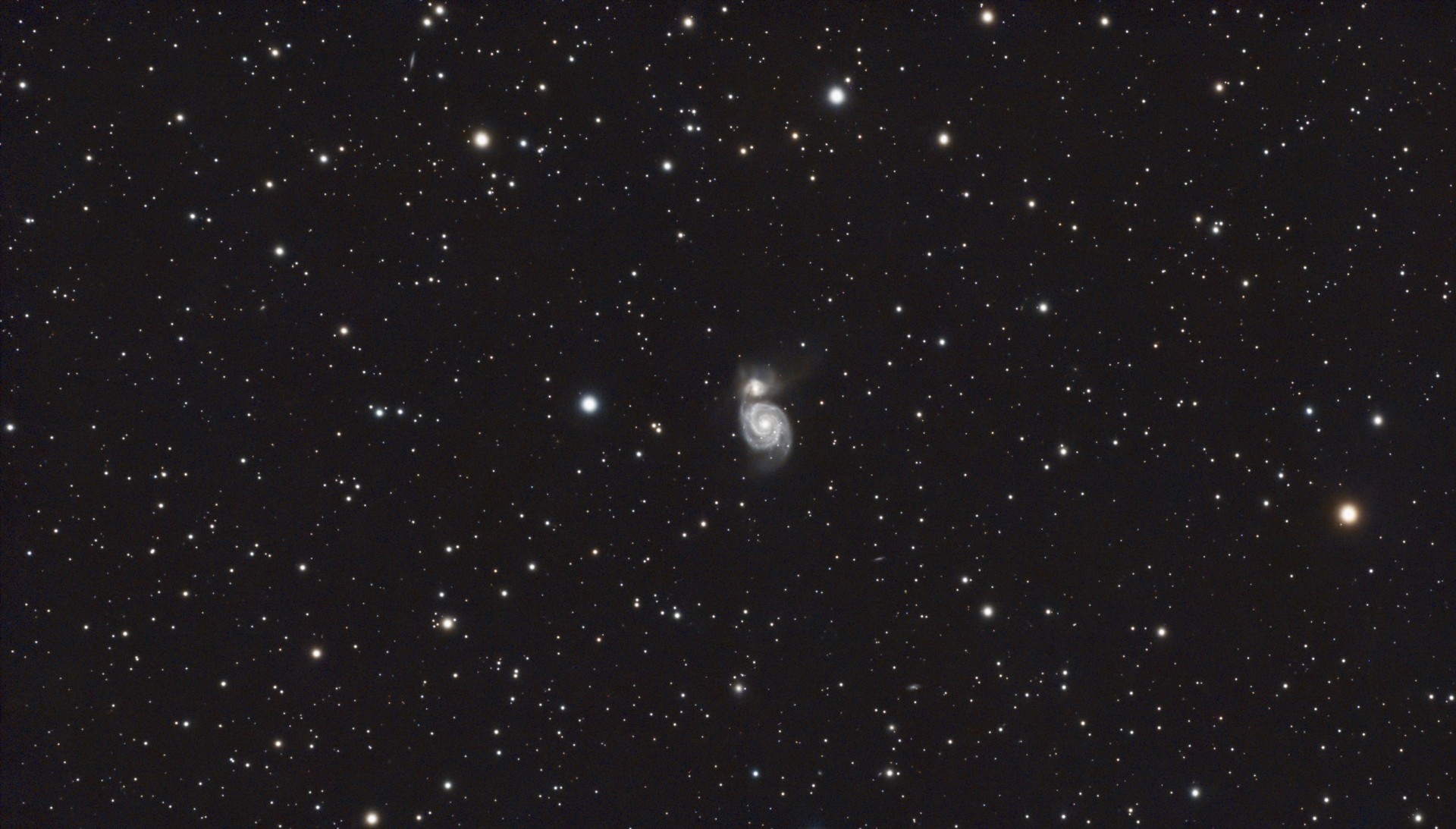
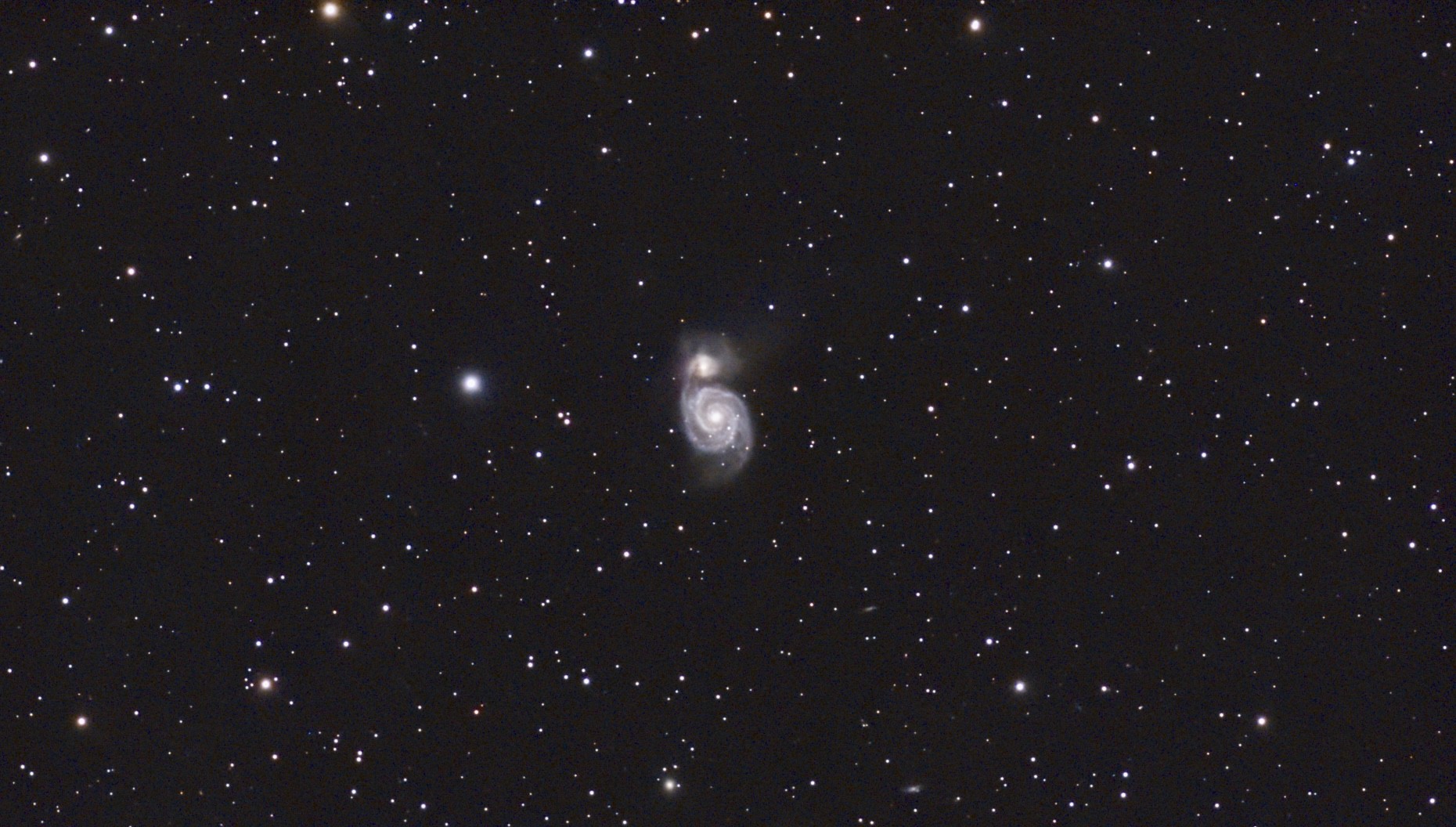
M51 is one of those targets that looks almost too good to be real — a grand design spiral seen nearly face-on, locked in a gravitational embrace with its smaller companion NGC 5195. The bridge of material connecting the two galaxies is visible even in modest integrations, and the spiral arm structure in M51 itself is among the most sharply defined of any galaxy accessible from UK skies. Running both the DWARF 3 and DWARF Mini simultaneously on the same night made for an interesting comparison: same target, same sky, same session parameters — and two quite different results.
The session ran on 17 March 2026 with identical settings on both scopes. Matching the parameters exactly was deliberate — 30-second subs at gain 60 on both telescopes makes for a clean like-for-like comparison, with aperture, focal length, and sensor as the only variables.
About M51 the Whirlpool Galaxy (NGC 5194)
M51 (NGC 5194) sits in Canes Venatici at a distance of around 23 million light-years, which puts it among the nearer spiral galaxies visible from the northern hemisphere. Its companion, NGC 5195, is a dwarf irregular galaxy that has made at least two close passes through M51's disc in the past few hundred million years — each pass triggering new waves of star formation in the spiral arms. The tidal bridge connecting the two is one of the most-photographed features in all of amateur astrophotography.
From Hampshire, M51 transits at around 65 degrees altitude in spring — high enough to minimise atmospheric dispersion and maximise the signal-to-noise in each sub. This is a target that rewards clean skies and patience more than brute integration time: the core is bright and the arms are relatively high surface brightness, so even 75 minutes of integration produces a usable result.
Capturing M51 with the DWARF 3 & DWARF Mini
Session Details — both telescopes identical
| Parameter | Value |
|---|---|
| Telescopes | DWARF 3 & DWARF Mini (simultaneous) |
| Filter | Astro (430–690nm) on both |
| Gain | 60 |
| Sub-exposure | 30 seconds |
| Frames stacked | 150 |
| Total integration | 75 minutes |
| Location | New Forest, Hampshire · Bortle 4 |
| Date | 17 March 2026 |
| Altitude at transit | ~65° above horizon |
| Stacking | DWARFLAB Stellar Studio (both) |
| Post-processing | DWARFLAB Stellar Studio · Apple Photos |
| Conditions | Seeing: very good · Transparency: good · No Moon |
Gain 60 on both scopes is a good choice for M51. The galaxy's core is bright enough that high gain would risk clipping, while the outer arm regions and the tidal bridge benefit from keeping read noise low on a shorter sub. 30-second subs at this gain level give a comfortable dynamic range across both the nucleus and the fainter bridge material.
Running both scopes simultaneously means the seeing and transparency are identical for both datasets — which makes the comparison genuinely fair. Any differences in the result are purely optical: the DWARF 3's wider 2.9° × 1.7° field against the DWARF Mini's tighter 2.4° × 1.2°, the 35mm aperture against 30mm, and the IMX678's 8.3MP versus the IMX662's 2MP.
Processing in Stellar Studio & Apple Photos
Both stacks were processed in Stellar Studio and then taken into Apple Photos for final adjustments. M51 is a broadband target so the Astro filter stack gives a natural colour result — the bluish star-forming knots in the outer arms contrast nicely with the warmer yellowish core population. I kept the stretch relatively conservative on both images to preserve the tonal separation between the nucleus, the inner arms, and the faint outer halo.
The tidal bridge between M51 and NGC 5195 is visible in both results, which at 75 minutes total integration is satisfying. The companion galaxy itself shows clearly, with the dust lane along its leading edge — the material being stripped from it by M51's gravity — just detectable in the DWARF 3 result where the higher resolution sensor has a little more to work with.
Final Image & Reflections
M51 is a benchmark target — it's bright enough to image in a short session but detailed enough that every extra hour of integration and every improvement in seeing conditions shows up in the final result. Both scopes handled it well within 75 minutes. The DWARF 3 gives a wider context frame with the surrounding star field, more pixels across the target, and slightly more aperture. The DWARF Mini frames M51 more tightly — the galaxy and companion fill more of the field — and the larger pixels of the IMX662 mean each pixel is collecting more photons per second, which partly compensates for the aperture difference.
As a dual-scope session this was exactly the kind of comparison that justifies running both simultaneously. The incremental effort of deploying two smart telescopes instead of one is minimal — and the results offer a genuinely useful insight into what each scope brings to a galaxy-season target.
Wider field, higher resolution. The better choice when you want more of the surrounding star field and maximum pixel count on the target.
Affiliate link — commission earned at no cost to you.
Tighter framing, larger pixels. 840g and pocket-sized — the grab-and-go companion that earns its place alongside the DWARF 3.
Affiliate link — commission earned at no cost to you.